“Dostawca zapewnił nam prawdziwie kompleksowe rozwiązanie w zakresie części. Ich zespół dopasował odpowiednie części Caterpillar, Perkins i filtry do naszego sprzętu, a wsparcie było szybkie i profesjonalne od zapytania do dostawy”.”
Kierownik ds. zaopatrzenia
Projekty części do ciężkiego sprzętu
co mówią o nas inni
“Dostawca zapewnił nam prawdziwie kompleksowe rozwiązanie w zakresie części. Ich zespół dopasował odpowiednie części Caterpillar, Perkins i filtry do naszego sprzętu, a wsparcie było szybkie i profesjonalne od zapytania do dostawy”.”
How to Estimate Remaining Useful Life in a Used Diesel Engine
A used CAT C9 engine shows 8,500 hours. It starts easily, idles smoothly, and has no obvious oil leaks. The seller calls it a good engine.
I’d still want to know its hot oil pressure and blow-by readings.
An engine can sound perfectly normal while its cylinder liners, piston rings, or bearings are already worn. I’ve also learned not to treat a low hour-meter reading as proof of good condition. A poorly maintained engine with 4,000 hours can be a worse purchase than one with 10,000 hours and a documented service history.
So how do we estimate used diesel engine life expectancy without dismantling the entire engine?
I would start with five things: verified operating hours, mechanical condition, oil analysis, maintenance records, and the engine’s previous working environment. None gives a complete answer alone. Together, they can help establish a reasonable estimate of remaining useful life (RUL).
The goal isn’t to predict the exact hour an engine will fail. It’s to determine whether it has enough productive life remaining to justify the purchase and any repairs it may need.
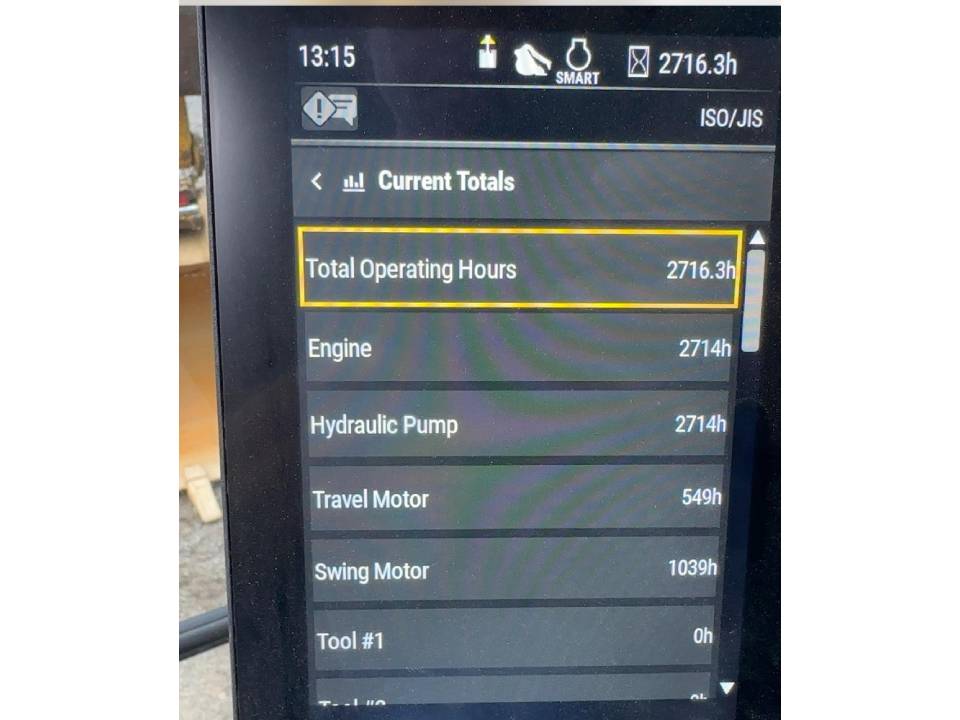
An hour meter measures operating time, not mechanical wear.
Consider two engines showing 7,000 hours. One powered a generator under relatively stable loads. The other worked in an excavator exposed to dust, frequent load changes, and high ambient temperatures.
Their wear histories may be very different.
The excavator engine could have experienced more abrasive contamination and thermal stress. The generator engine, meanwhile, might have suffered from prolonged low-load operation, depending on its operating conditions.
I wouldn’t declare either engine healthier without testing it.
What operating history should we check?
For electronically controlled CAT and Perkins engines, I would request available ECM information, including recorded hours, diagnostic events, and operating data supported by the particular engine.
It’s also worth checking whether the engine has been replaced. A machine showing 6,000 hours may have a different engine installed from the one it originally left the factory with.
The engine serial number, machine identification, and service records should agree.
If they don’t, the hour-meter reading becomes less useful.
Are 10,000 hours too many?
Not necessarily.
A CAT C15 operating under one duty cycle cannot be judged against the same assumed lifespan as a Perkins 1106 working under another. Engine rating, load, maintenance, and application all affect durability.
I would be more concerned about an engine with 5,000 hours, excessive blow-by, and unexplained coolant loss than a 10,000-hour engine with normal mechanical test results and a verifiable maintenance history.
Hours tell us where to start investigating. They don’t tell us when to rebuild.
How to Check the Actual Condition of a Used Diesel Engine
A proper used diesel engine condition assessment doesn’t always require expensive equipment or a complete teardown.
For an initial inspection, I would prioritize a cold start, crankcase blow-by, hot oil pressure, oil analysis, and cooling-system condition.
If those checks reveal problems, further testing may be necessary.
Cold Start and Exhaust Smoke
Ask the seller not to warm up the engine before inspection.
A cold start can reveal poor cranking, difficult starting, unstable idle, and combustion problems that become less obvious after the engine reaches operating temperature.
Smoke color provides clues, although it doesn’t identify a failed component by itself.
Observation
Possible cause
Next inspection
Blue smoke
Oil entering combustion chambers
Rings, turbocharger, valve guides
Persistent white smoke
Unburned fuel or possible coolant entry
Injectors, compression, cooling system
Black smoke under load
Air restriction, excessive fueling, poor combustion
Air filter, boost pressure, injectors
Long cranking
Starting-system, fuel, or compression problem
Battery, starter, fuel supply, compression
Unusual knocking
Combustion or mechanical problem
Injector operation, oil pressure, noise source
I wouldn’t reject an engine because of a brief puff of smoke immediately after starting. Ambient temperature and engine design matter.
Persistent blue smoke accompanied by high oil consumption is a different matter. That deserves investigation before purchase.
Blow-by and Compression
Blow-by is combustion gas escaping past the piston rings into the crankcase.
Some blow-by is normal. Excessive blow-by can indicate worn rings, cylinder liner damage, or other sealing problems.
But removing the oil filler cap and watching it bounce isn’t a proper blow-by test.
I’d use the manufacturer’s specified measuring method, with the engine at the required temperature, speed, and load.
What is an acceptable blow-by reading?
There is no single limit that applies to every diesel engine.
A CAT C7, CAT C15, and Perkins 1106 have different designs and testing requirements. Even engines within the same family may have different applicable specifications.
Without the engine model, serial number, test procedure, and operating conditions, a blow-by number doesn’t mean much.
Compression testing can provide additional evidence when starting behavior or cylinder sealing is questionable. But I wouldn’t remove injectors or other components solely to obtain compression readings if less invasive tests already provide sufficient information.
Hot Oil Pressure
Cold oil is thicker than hot oil. That’s why an engine can show apparently good oil pressure immediately after starting but develop low pressure after warming up.
For a meaningful reading, I would measure oil pressure at the specified operating temperature and engine speed, preferably using a suitable calibrated gauge.
Low hot oil pressure may indicate excessive bearing clearances, oil pump wear, relief-valve problems, incorrect lubricant viscosity, or fuel dilution.
Don’t assume the crankshaft bearings are worn until other possible causes have been checked.
And don’t accept a dashboard gauge reading without knowing whether the sensor and instrument are accurate.
Oil Analysis and Wear Metals
Oil analysis is particularly valuable when inspecting an engine that cannot be dismantled.
I would pay attention to iron, copper, lead, aluminum, silicon, fuel dilution, viscosity, soot, and evidence of coolant contamination.
These measurements can indicate wear or contamination, but they need interpretation.
For example, elevated iron may originate from several ferrous components. Silicon can indicate dirt entering through the intake system, but it can also come from additives or sealants.
The most useful information often comes from changes over time.
The researchers identified several degradation patterns involving metallic wear, oxidation, contamination, and viscosity changes. They also detected changes in degradation behavior at approximately 346 and 444 service hours under the studied conditions.
MDPI
Those figures aren’t universal oil-change intervals. The fleet had its own operating environment and maintenance requirements.
Another 2025 study in Mechanical Systems and Signal Processing examined 820 oil samples from 169 commercial vehicles collected over four years. The researchers investigated how engine characteristics and operating information could help predict oil degradation.
ScienceDirect
Both studies reinforce something I’d apply during an engine inspection: oil condition should be evaluated alongside operating history, not in isolation.
Caterpillar’s S•O•S fluid sampling guidance also emphasizes consistent sampling intervals and clean sampling procedures to establish meaningful trends.
Caterpillar
One clean oil report collected immediately after an oil change is much less informative than several comparable samples collected over time.
Cooling System
Cooling-system problems can shorten engine life long before the hour meter looks excessive.
A leaking hose may be inexpensive to replace. Damage caused by repeated overheating may not be.
I’d check coolant level, radiator condition, hoses, thermostat operation, water pump condition, and evidence of previous overheating. A pressure test can help identify leaks, provided the correct procedure is used.
What if coolant keeps disappearing?
First check for external leaks. Then investigate possible internal leakage, including cylinder head gasket problems or other defects.
Coolant contamination in engine oil is particularly concerning because it can interfere with lubrication and contribute to bearing damage.
On a CAT 330 or 330 GC excavator, a component such as the 559-1891 genuine Caterpillar coolant hose may be relevant when repairing the cooling system. Exact fitment must be verified against the machine configuration.
Marine engines need additional attention. Seawater circulation, heat exchangers, corrosion, and pump condition can all affect cooling performance. The 524-3160 Caterpillar genuine sea water auxiliary pump is an example of an application-specific cooling component.
Replacing a failed hose or pump fixes that particular defect. It doesn’t reverse internal damage caused by earlier overheating.
How Maintenance History Affects Remaining Engine Life
When evaluating diesel engine maintenance history, I look for evidence of what was actually done, not just a statement that the engine was serviced regularly.
A seller might say the oil was changed every 250 hours. That’s useful only if the interval was appropriate for the engine and the claim can be supported.
I’d ask for service invoices, oil specifications, filter replacement records, coolant maintenance, and any previous major repairs.
What if the engine has no service records?
Missing records don’t automatically mean poor maintenance. Older machines often change owners, and paperwork gets lost.
But I wouldn’t assign the same confidence to an undocumented engine as one with consistent maintenance evidence.
If the records are missing, current mechanical tests become more important. I’d also allow for greater uncertainty when calculating the purchase price.
Does an engine overhaul reset its lifespan?
Not automatically.
Suppose a CAT C15 has 14,000 hours and recently received new injectors, a turbocharger, and cylinder head repairs.
That work may improve reliability, but it doesn’t make the crankshaft, bearings, pistons, or cylinder liners new.
A documented major overhaul involving internal component inspection, replacement, machining, and testing carries more weight than an invoice simply stating “engine rebuilt.”
I’d want to see which components were replaced, what measurements were recorded, and whether the finished engine passed the required tests.
Parts quality matters too. A correctly identified genuine component and an unverified replacement part may present different purchasing considerations, but the actual workmanship and inspection results still determine whether the repair was successful.
How to Estimate Diesel Engine Remaining Useful Life
There isn’t a universal formula that predicts exactly when a used diesel engine will fail.
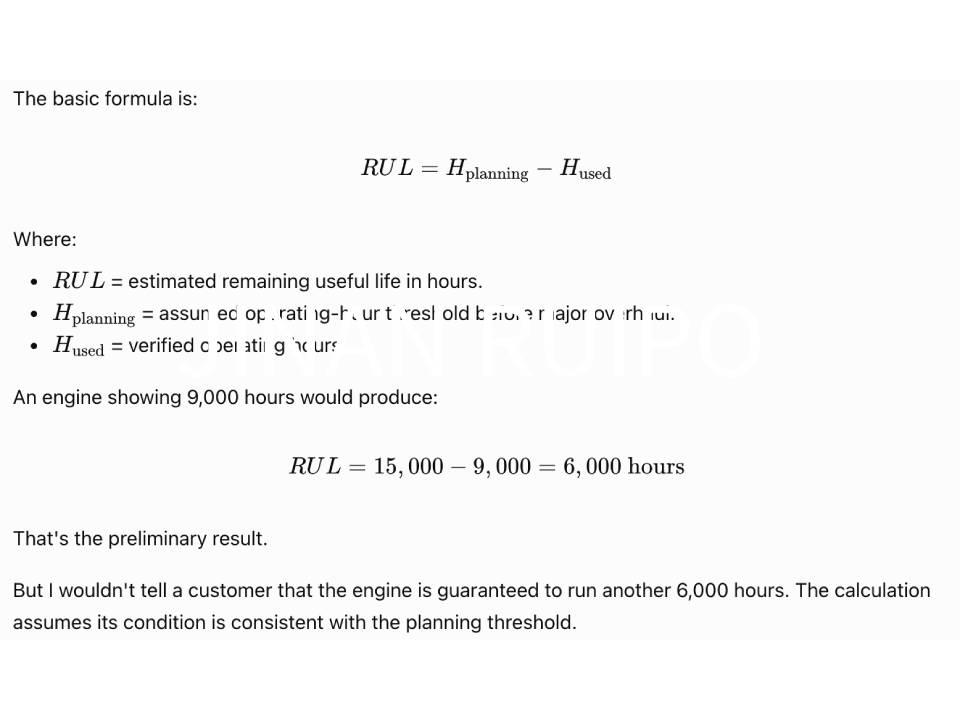
However, we can develop a practical estimate using a defined service-life threshold, verified operating hours, and inspection evidence.
Step 1: Establish a reasonable planning threshold
Start with engine-specific manufacturer information, comparable fleet maintenance records, and any documented overhaul history.
For illustration, suppose an importer adopts a planning threshold of 15,000 operating hours for a particular engine application.
This is a hypothetical assumption, not a CAT or Perkins standard.
Step 2: Calculate the preliminary remaining life
Step 3: Adjust the assessment using inspection results
Consider the same 9,000-hour engine under three different conditions.
Scenario
Mechanical and maintenance evidence
Illustrative remaining life
Favorable
Documented maintenance, acceptable blow-by and oil pressure, stable oil-analysis trends
6,000 hours
Base
Acceptable current tests, incomplete service records, uncertain duty cycle
4,000 hours
Adverse
Abnormal wear indicators, possible internal repairs, missing maintenance history
1,500 hours
These are purchasing scenarios, not manufacturer-approved predictions. The estimates would need to be justified using actual inspection results and comparable engine data.
I wouldn’t apply arbitrary deductions such as reducing RUL by 20% because the oil pressure is low. Low oil pressure requires diagnosis, and the repair could range from relatively minor to a major overhaul.
Step 4: Check whether the purchase still makes financial sense
Suppose a used engine costs $15,000, with another $3,000 expected for repairs and contingency.
If its estimated remaining productive life is 4,000 hours:
That’s the estimated acquisition cost per productive hour, excluding future fuel, maintenance, downtime, and resale value.
Now consider a cheaper engine requiring major repairs after only 1,500 hours. Its lower asking price may not represent better value.
For importers, I would calculate both the expected remaining hours and the likely cost of reaching them.
Used Diesel Engine Inspection Checklist
Before paying for a used CAT or Perkins engine, I’d want the following information.
Inspection item
What to verify
Priority
Engine identification
Model, serial number, arrangement
Essential
Operating hours
Meter reading, ECM data where available
Essential
Cold start
Starting time, smoke, unusual noise
Essential
Blow-by
Manufacturer-approved measurement
Wysoki
Oil pressure
Hot reading at specified engine speed
Essential
Oil analysis
Wear metals, viscosity, contamination
Wysoki
Układ chłodzenia
Leaks, coolant condition, operating temperature
Essential
Maintenance history
Oil changes, filters, previous repairs
Wysoki
Load performance
Power delivery, smoke, temperatures
Wysoki
Overhaul history
Replaced components and test records
Wysoki
I would also separate engine faults from problems affecting the rest of the machine.
If I’m evaluating a complete used excavator, I want separate estimates for engine condition, hydraulic repairs, electronics, and undercarriage wear.
Otherwise, it’s easy to overestimate or underestimate the cost of putting the machine back to work.
Najczęściej zadawane pytania
How many hours can a used diesel engine last?
Used diesel engine life expectancy depends on engine design, operating conditions, maintenance, and current mechanical condition. There is no fixed number of hours that applies to every engine. A well-maintained engine with higher operating hours may have more remaining useful life than a lower-hour engine showing significant wear.
How do I know if a used diesel engine is worn out?
I would check for excessive blow-by, low hot oil pressure, abnormal oil consumption, persistent exhaust smoke, poor starting, and signs of overheating. These symptoms can indicate internal wear, but some also result from repairable faults. Mechanical testing is needed before deciding whether the engine requires an overhaul.
Is 10,000 hours too much for a CAT or Perkins engine?
Not necessarily. I would assess a 10,000-hour engine using its exact model, operating history, maintenance records, and inspection results. The number alone doesn’t determine whether an engine is near the end of its useful life. Its intended application and expected repair costs also matter.
Can oil analysis predict remaining engine life?
Oil analysis can identify lubricant degradation, contamination, and signs of abnormal component wear. It cannot independently predict the exact number of hours remaining. I would use repeated oil-analysis results alongside blow-by measurements, oil pressure, maintenance history, and other mechanical tests.
Does rebuilding a diesel engine make it as good as new?
Not automatically. The result depends on which components were replaced, the condition of reused parts, machining quality, assembly procedures, and final testing. I would review the overhaul records before estimating how much additional service life the rebuild might provide.
Final Thoughts: Check Before You Buy
When buying a used diesel engine, I wouldn’t make the decision based on operating hours or appearance alone.
I’d first verify the engine serial number and available maintenance history. Then I’d check cold-start behavior, blow-by, hot oil pressure, oil condition, and cooling-system performance. If anything looks questionable, further testing should come before negotiating the final price.
For a used CAT or Perkins engine, the most useful estimate isn’t an exact failure hour. It’s a realistic range of remaining productive life supported by mechanical evidence.
If the engine needs repairs, identify the required components before calculating the total purchase cost.
Przy RUIPO Spare Parts, buyers can inquire about CAT and Perkins replacement parts for maintenance and repair projects. Provide the engine model, serial number, and required part numbers so compatibility and availability can be checked.
Don’t pay for the hours an engine claims to have left. Pay for the condition you can verify.