“O fornecedor ofereceu-nos uma verdadeira solução de peças num só local. A sua equipa fez corresponder as peças Caterpillar, Perkins e de filtro certas para o nosso equipamento, e o apoio manteve-se rápido e profissional desde a consulta até à entrega.”
Gestor de aquisições
Projectos de peças para equipamento pesado
o que os outros dizem sobre nós
“O fornecedor ofereceu-nos uma verdadeira solução de peças num só local. A sua equipa fez corresponder as peças Caterpillar, Perkins e de filtro certas para o nosso equipamento, e o apoio manteve-se rápido e profissional desde a consulta até à entrega.”
Vida útil total da máquina vs. vida útil do motor: o que os compradores B2B devem distinguir
No ugly knock. No blue fog hanging over the yard. Oil pressure looks respectable, coolant stays where it belongs, and the hour meter doesn’t immediately scare anybody away.
That’s heavy equipment lifespan in the real world. Messy.
Índice
The problem is that buyers still like one number. Usually hours.
I understand why. Hours are easy to compare, easy to put in a spreadsheet, easy for an auction listing to advertise. But once we’re talking about used excavators, loaders, dozers or other capital equipment, the hour meter is only recording elapsed operation; it isn’t measuring hydraulic contamination, shock loading, crack propagation, overheating events, poor greasing or how many shifts the machine spent hammering rock instead of moving loose material.
Same clock. Very different punishment.
And that’s the separation B2B buyers need to make: heavy equipment engine life is not whole-machine life.
A Machine Doesn’t Age as One Piece
Think about what is actually happening during 10,000 machine hours.
The crankshaft sees one kind of load.
A boom foot sees another.
Main hydraulic pumps live with pressure, heat, oil cleanliness and cavitation risk. Pins and bushings care about grease and abrasive dirt. Final drives couldn’t care less about your injector condition. Wiring connectors fight vibration, water, heat and previous repair work. The undercarriage, meanwhile, is basically being ground away one travel cycle at a time.
Yet somebody asks, “How many hours are on it?”
That’s the shortcut.
Caterpillar’s own rebuild system is a useful reality check here. In its 2024 material, Caterpillar separates Complete Machine, Various Machine Components, Complete Power Trains, Commercial Engines and Hydraulic Systems into distinct rebuild categories rather than treating them as one wear package. A complete Cat Certified Rebuild involves more than 350 tests and inspections and automatic replacement or reconditioning of approximately 7,000 parts.
That separation isn’t academic.
Since 1985, Cat dealers have completed more than 50,000 certified rebuilds involving machines, powertrains and components.
Read that again.
The industry has spent decades rebuilding different sections of the same capital asset at different points in its life. So the idea that one engine-hour figure somehow describes the heavy equipment lifecycle of every system attached to that engine has never made much mechanical sense.
But it’s convenient.
That’s why it survives.
Hours show exposure. They don’t show the beating.
Picture two excavators. Same model. Same year. Both at 8,700 hours.
One loaded reasonably loose material, had operators who weren’t trying to beat the cycle-time record every pass, received grease when it was supposed to, and didn’t spend its summers with a cooling package packed full of dust.
The other lived on a breaker.
Which machine has more life?
You can’t answer that from 8,700.
This gets even more interesting when digging conditions change. A 2024 Monash University study examined hydraulic excavators working with different material cohesion, particle-size distributions and bucket trajectories. Higher cohesion increased hydraulic-power fluctuation, while changes in particle distribution altered interaction forces and stress distribution on the bucket.
Or, in shop language: what the bucket bites into matters.
So when someone asks how long does heavy equipment last, the answer cannot begin with a generic hour range and stop there.
Not if money is involved.
The Engine Can Be Healthy While the Machine Is Tired
Here’s a situation I would distrust immediately.
“Engine recently rebuilt. Machine in excellent condition.”
Those two statements are not synonyms.
Maybe the rebuild was excellent. Maybe compression is good, cold starting is crisp, blow-by is under control, fuel delivery is clean and the cooling system has no nasty surprises.
Fine.
What happened to the rest of the machine during the previous 12,000 hours?
Nobody turned the structural fatigue clock back to zero when the engine came out.
Nobody magically tightened worn bores in the boom linkage.
A rebuilt engine does not reverse wear inside hydraulic pumps or final drives. It doesn’t restore track-chain pitch. It doesn’t undo heat damage inside an electrical connector. It certainly doesn’t erase a badly executed structural repair that has already been carrying cyclic loads for another 3,000 hours.
That’s why machine life vs engine life deserves its own calculation.
Look at structural failure research and the gap becomes hard to ignore. A 2024 failure analysis of a bucket-wheel excavator’s discharge boom suspension found a typical fatigue crack originating around a notch in a highly stressed component. Calculated von Mises stress around that notch reached roughly 471 MPa.
471 MPa.
The prime mover could have been running beautifully.
Didn’t matter.
A structural component had its own failure mechanism, its own stress history and, effectively, its own clock.
This is the part of used heavy equipment lifespan that gets lost when buyers stare too hard at an engine-hours figure.
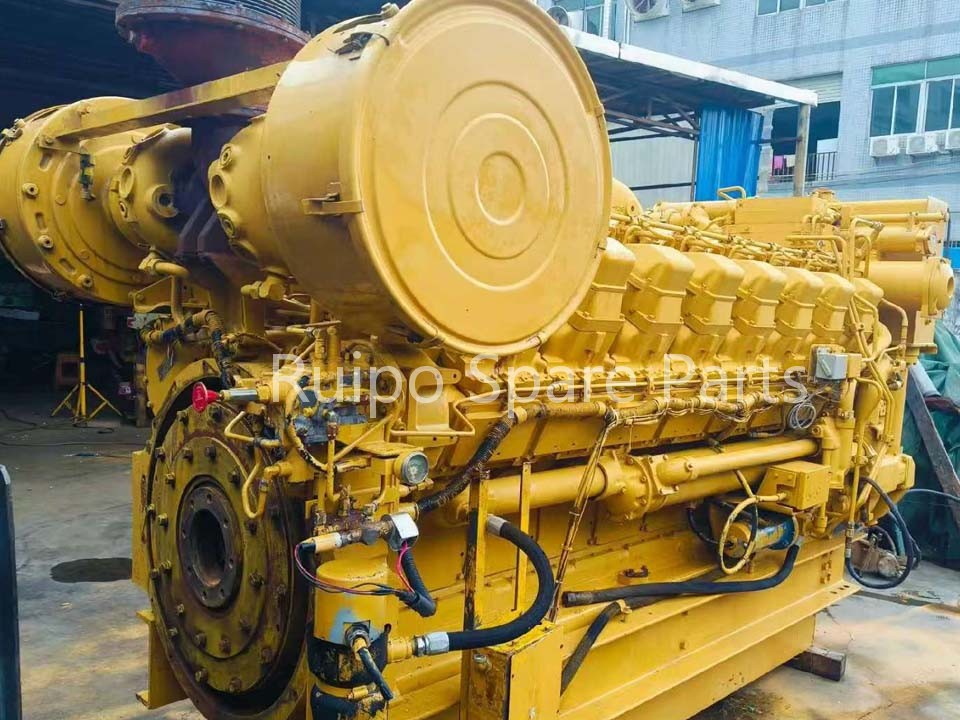
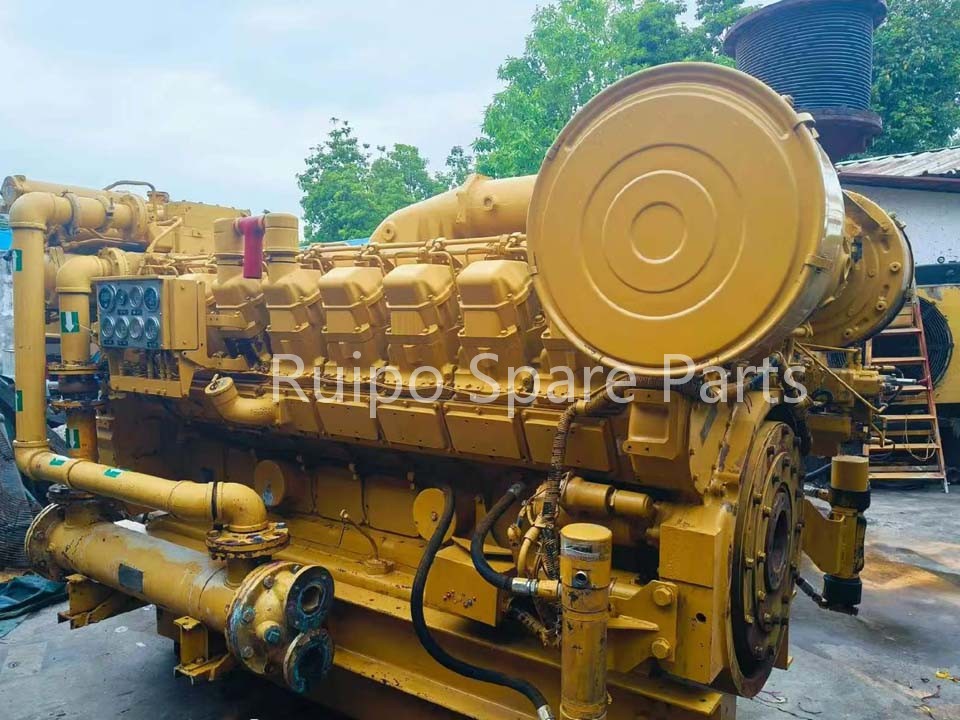
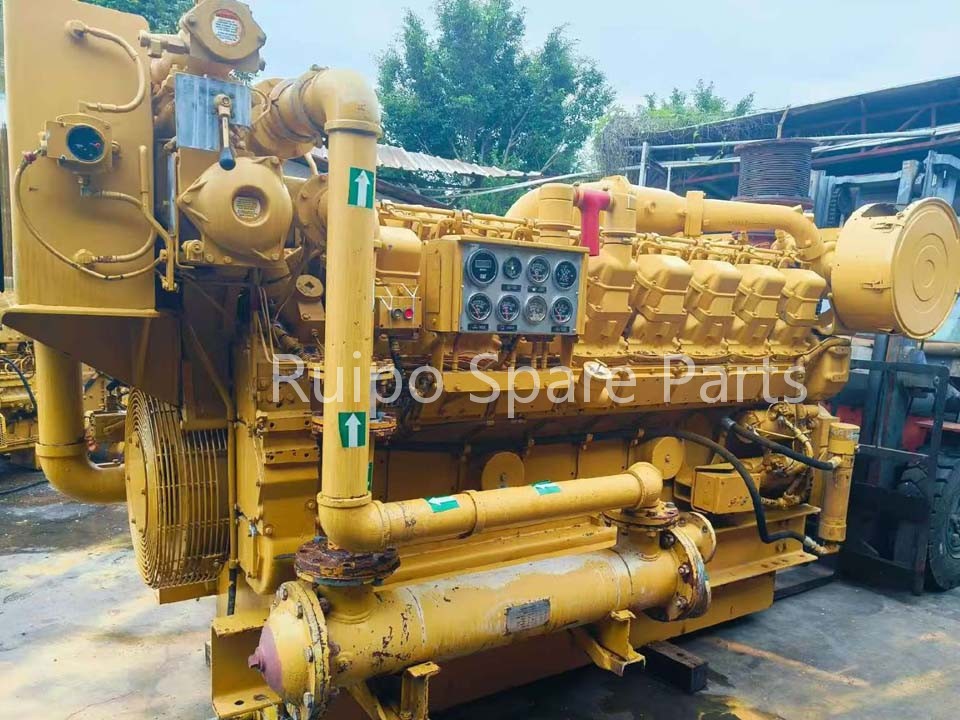
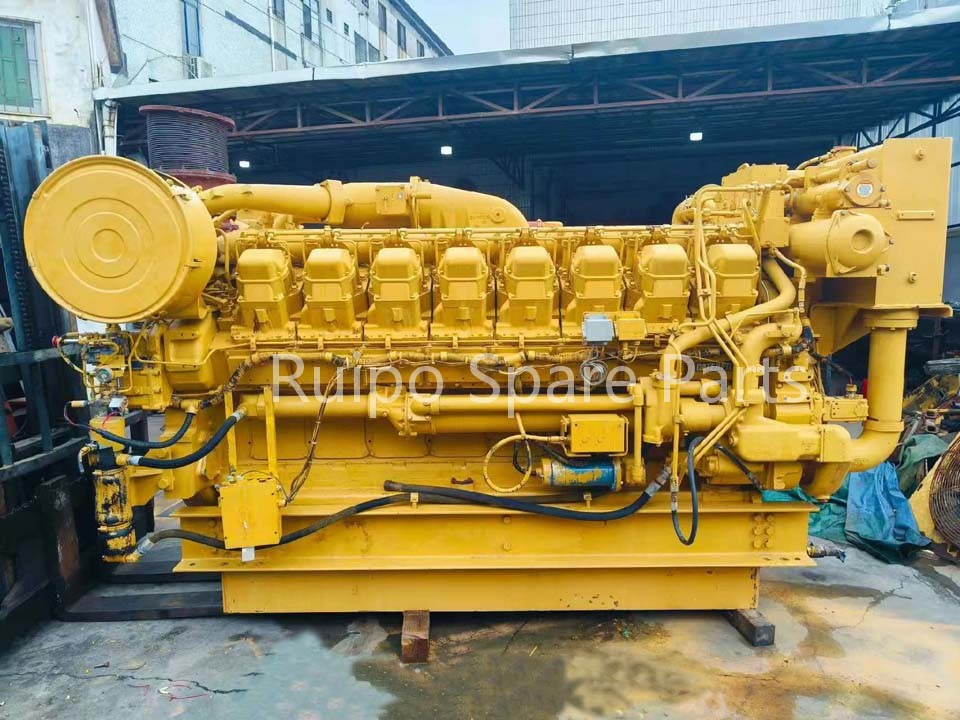
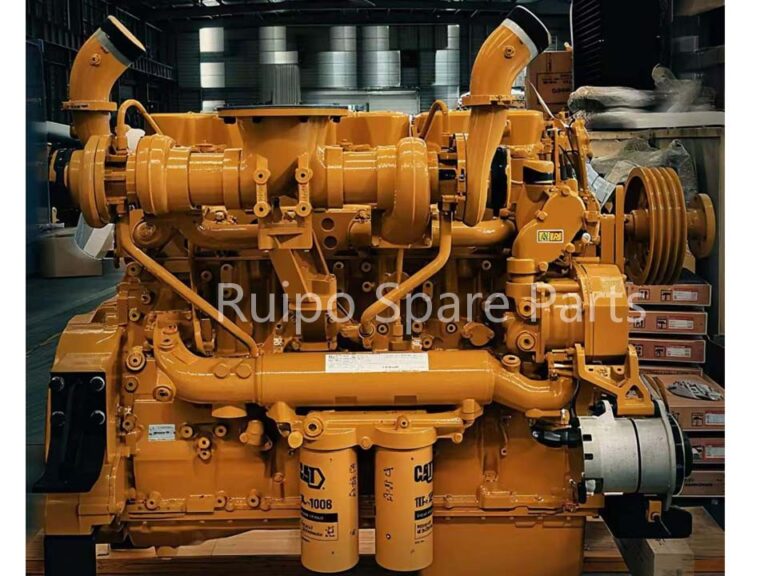
Vista lateral do motor industrial Cat – Vida útil do motor
Machine Life vs Engine Life: What Actually Wears First?
There is no universal order. But this is the framework I would use when screening a serious used-equipment purchase.
Electronics can create costly downtime on mechanically sound machines
Cooling / accessories
Dust loading, corrosion, bearing wear, belt load
Radiators, coolers, pulleys, heaters, fan system
Small-system neglect can trigger much larger failures
There it is.
Six systems. Six aging patterns.
And that’s still simplified.
On an excavator I’d want to know pump condition, main control valve leakage, swing bearing play, swing drive condition, final-drive history, track wear, boom and stick repairs, cylinder leakage, cooling efficiency, fault-code history and engine condition.
Not necessarily in that order.
Actually, I’d often inspect the structure before getting excited about the engine.
Porquê?
Because an injector is replaceable.
A machine with ugly structural history can become a completely different commercial problem.
“Useful Life” Is an Accounting Number Until Proven Otherwise
This phrase causes more confusion than it should:
equipment useful life.
Useful to whom?
Accounting?
Tax?
Fleet planning?
Maintenance?
Resale?
A machine can have four different answers depending on which department is sitting at the table.
Indiana’s 2024 state-agency asset guidance, for example, assigns graders a useful life of 120 months while listing construction and engineering equipment at 60 months.
Five years versus ten.
Does that mean a grader physically expires at month 120?
Of course not.
Those figures are accounting classifications. They’re useful for capital-asset treatment; they are not a mechanic’s diagnosis of remaining iron.
This isn’t just an accounting technicality. The FAA makes a similar distinction from another direction. Its guidance says that reaching minimum useful life doesn’t automatically justify rehabilitation, reconstruction or replacement when equipment continues performing as intended.
I like that distinction because it kills the idea of a universal expiry date.
A machine can be old on paper and productive in the dirt.
Or young on paper and awful to own.
We’ve all seen the logic, even without calling it lifecycle analysis: the neglected machine with fewer hours gets marketed as the “better” unit, while the higher-hour fleet machine has service records thick enough to hurt somebody if the binder falls off the shelf.
Which would you rather finance?
Exactly.
Parts History Tells a Story — Just Don’t Read Too Much Into It
Maintenance records matter.
Individual parts matter too.
But buyers sometimes give recent repair invoices more credit than they deserve.
It tells me somebody worked on a defined part of the fuel system. Depending on why it was changed and what diagnostics were performed, that may reduce uncertainty around one engine issue.
One.
It doesn’t tell me what the hydraulic pump looks like internally. It says nothing about swing-bearing clearance. It doesn’t measure the rails. It won’t tell me whether an old boom crack is quietly working its way beside a repair plate.
A renewed fuel-system component isn’t a renewed excavator.
Short sentence. Big difference.
Even relatively straightforward maintenance items can be useful clues without becoming proof of overall condition. Records for a CAT 7E-4839 8-groove alternator pulley tell me somebody was maintaining accessory-drive hardware. Good.
But don’t make the leap from “maintained pulley” to “excellent machine.”
That’s sales-yard arithmetic.
Likewise, documentation for a CAT 213-8193 240V coolant heater can tell you something about the machine’s configuration and cold-weather preparation.
Could be relevant.
Still doesn’t reset engine life expectancy, much less the entire machine.
My rule is simple: treat each repair as evidence about the system it actually touched.
Don’t let one shiny invoice repaint the whole asset.
Hydraulic System Lifespan Usually Deserves More Attention
Engines get emotional attention.
Hydraulics get invoices.
That’s why I wouldn’t buy an excavator without testing it hot.
Cold oil can flatter a worn hydraulic system. Once operating temperature comes up, internal leakage becomes harder to hide, pump performance is easier to judge and cycle behavior begins telling a more useful story.
Run it.
Dig with it.
Hold functions against load where the manufacturer’s testing procedure allows. Watch drift. Listen for pump noise. Compare left and right travel. Pay attention to cycle speed after the oil is properly warm—not three minutes after somebody starts the machine for an inspection.
And check the oil.
Contamination, overheating and aeration can be far more revealing than polished paint.
O hydraulic system lifespan isn’t tied neatly to engine hours because hydraulic components respond to cleanliness, oil viscosity, pressure spikes, thermal history, filtration quality and work severity.
A machine doing repetitive heavy digging near relief pressure simply hasn’t lived the same hydraulic life as a lightly loaded unit at the same hours.
That’s the uncomfortable bit for buyers who want a simple formula.
There isn’t one.
Structures Keep Their Own Memory
Paint is cheap.
Fatigue isn’t.
I pay attention to weld toes, transitions in section thickness, boom-foot areas, stick ends, bucket linkages, mounting points and anywhere previous reinforcement plates appear.
A repair isn’t automatically bad, by the way.
Heavy equipment works. Steel cracks. Competent structural repair exists.
But I want to know what cracked, why it cracked, how the repair was prepared, whether the crack was completely removed, what welding procedure was used and whether the root cause was fixed.
Big difference between those answers.
The 2024 bucket-wheel excavator case mentioned earlier is useful precisely because it shows how localized stress and material condition can produce fatigue failure independent of whatever the engine is doing.
This is why I don’t like hearing “only 7,000 hours” presented as a complete condition report.
Only?
Seven thousand hours of what?
Loading sand?
Hammering concrete?
Digging blasted rock?
Working on salt-contaminated ground?
Sitting at high idle?
The hour meter remains the same kind of instrument through all five scenarios.
The steel doesn’t.
Then There Is a Third Clock: Market Life
Here’s where mechanical people sometimes get annoyed.
A perfectly serviceable machine can become less attractive economically before anything major breaks.
Suddenly the same 8,000-hour excavator has a different commercial profile.
Reuters reported in April 2024 that Caterpillar dealer inventories had risen by about $1.1 billion, while first-quarter Construction Industries sales fell 5%.
A machine might physically run another 6,000 hours yet become uneconomic after 2,000 because the next sequence of pump, undercarriage and structural repairs destroys the cost-per-hour target.
Another machine might look old, have plenty of hours and keep earning because the major systems have known history, parts supply is good, downtime is predictable and the purchase price already reflects its age.
Ugly machine. Good asset.
It happens.
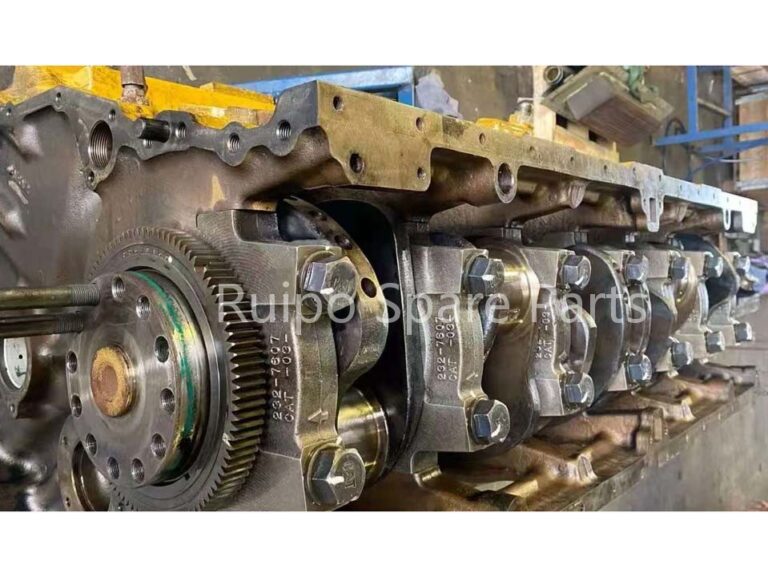
Vista lateral do motor industrial Cat – Vida útil do motor
How I’d Inspect Used Heavy Equipment Before Talking Price
Price comes later.
First, I want to know what I’m pricing.
Start with the steel
Walk around before the engine is even started.
Look underneath fresh paint. Check boom, stick, frames, mounts and repaired areas. Look for weld profile changes, plates that don’t belong there, grinding marks and geometry that seems slightly wrong.
A used-machine purchase gets expensive when adjectives replace measurements.
Get the hydraulics hot
Not warm.
Hot.
A five-minute demonstration around a dealer yard isn’t enough for a serious hydraulic assessment. Cycle the machine. Load it. Watch drift. Feel for hesitation. Listen.
If performance changes materially as temperature rises, I want to know why before a purchase order exists.
Read the machine’s electronic history
Modern equipment talks.
Fault codes, logged events and controller information can expose intermittent problems that disappear the second a buyer arrives.
A repaired wire harness can look perfectly fine from ten feet away.
The ECM may have a longer memory.
Now give the engine its turn
Cold start if possible.
That’s important—the seller starting it before you arrive removes useful information.
Then look at smoke behavior, blow-by, abnormal noise, coolant condition, oil condition, oil pressure where data is available, fuel-system behavior and service history.
Oil analysis?
Even better.
The engine matters enormously. I’m not minimizing it.
I’m putting it in its correct box.
The Hour Meter Is a Clue, Not a Valuation Model
This annoys people because hours are so easy.
5,000 sounds good.
12,000 sounds scary.
But consider a hypothetical machine with 12,000 hours where the engine was professionally rebuilt at 9,500, pumps were done at 10,200, undercarriage at 11,000, structural inspection shows no meaningful concerns, service records are complete and the machine spent its life in predictable fleet work.
Then consider the 5,400-hour machine with unknown history, repaired overheating damage, welded boom, contaminated hydraulic oil and an owner who can’t tell you when the final-drive oil was last changed.
Which one has more equipment useful life left?
Now we’re asking the right question.
Not:
“How many hours?”
But:
“What has already been consumed, what has already been renewed, and what expensive life remains?”
That’s B2B equipment valuation.
Perguntas frequentes
How long does heavy equipment last?
Heavy equipment lifespan is the period a machine can remain productive and economically supportable, but there is no single universal hour limit because its engine, hydraulic system, structure, drivetrain, undercarriage and electronic controls accumulate wear at different rates depending on load severity, maintenance quality, environment, operator behavior and previous repair history.
That’s why hour ranges should be treated as context rather than an expiration date. A maintained high-hour machine can have substantial productive life remaining, while a lower-hour machine exposed to heat, contamination, shock loading or poor lubrication may already be carrying major repair risk.
Is engine life expectancy the same as whole-machine life?
Engine life expectancy describes the expected service duration of the diesel engine, whereas whole-machine life includes the remaining condition of hydraulics, structural members, drivetrain, undercarriage, cooling hardware, electrical systems and controls, meaning the engine can reach overhaul earlier—or considerably later—than the rest of the equipment becomes economically worn.
That’s the separation buyers should keep in mind when a seller emphasizes a recently rebuilt engine. The engine may indeed be excellent. The rest of the machine still needs its own inspection.
Can an engine outlast the rest of a heavy machine?
Yes, a diesel engine can outlast the rest of a heavy machine when good filtration, lubrication, cooling and maintenance preserve the power unit while repeated shock loads, hydraulic contamination, abrasive travel, structural fatigue or neglected joints progressively consume other systems whose repair cost may eventually exceed the machine’s economic value.
Quarry, demolition and severe excavation duty are good examples of why hours without application history can mislead.
Why can two machines with the same hours have different remaining life?
Two machines with identical hour-meter readings can have very different remaining life because operating hours record time, not the severity of hydraulic pressure cycles, digging resistance, travel distance, idle percentage, heat exposure, contamination, attachment use, operator technique, overload events or cumulative structural stress experienced during those hours.
That’s why duty cycle deserves nearly as much attention as hours themselves.
Five thousand easy hours and five thousand ugly hours are both “5,000” on the display.
The components know the difference.
What should a B2B buyer check before buying used heavy equipment?
A B2B buyer should inspect the structure, wear points, hydraulic system, drivetrain, undercarriage, electrical controls, cooling package and engine as separate condition groups, then compare likely repair exposure and downtime against purchase price, expected production, parts availability and resale value instead of allowing engine hours alone to determine whether the machine is commercially attractive.
Service records make this easier. So do diagnostic downloads, oil analysis, cold-start observation and a properly warmed operational test.
Does a rebuilt engine reset heavy equipment lifespan?
No, an engine rebuild resets or renews selected engine components according to the scope of that overhaul, but it does not reset accumulated wear in the hydraulic system, frame, boom, bearings, undercarriage, transmission, final drives, wiring, cooling package or other machine systems that continued aging during the equipment’s previous service life.
This is probably the single distinction I’d want a purchasing team to remember.
Rebuilt engine.
Not rebuilt machine.
Buy the Life That’s Left — Not the Story Around the Hour Meter
Used-equipment sellers need a simple story.
Buyers don’t.
“Low hours.”
“Rebuilt engine.”
“Runs strong.”
“Ready to work.”
Those statements may all be true and still fail to answer the question that actually matters: how much economically useful machine is left?
So separate the clocks.
Engine life.
Hydraulic life.
Structural life.
Drivetrain and undercarriage life.
Electrical and control-system condition.
Then market life—the point at which keeping the machine no longer makes commercial sense even though somebody can still turn the key tomorrow morning.
That’s how I would judge heavy equipment lifespan.
Not by searching for one magic number.
If you’re maintaining an existing CAT fleet and need genuine parts, send RUIPO Spare Parts the part number, machine model, engine model and required quantity. We can help verify the part information before quotation and international shipment, whether you’re tracing an engine-system component or keeping an older machine productive through the next stage of its service life.