“Поставщик предоставил нам настоящее универсальное решение по запчастям. Их команда подобрала нужные запчасти Caterpillar, Perkins и фильтры для нашего оборудования, а поддержка была быстрой и профессиональной от запроса до поставки”.”
Менеджер по закупкам
Проекты запчастей для тяжелой техники
что о нас говорят другие
“Поставщик предоставил нам настоящее универсальное решение по запчастям. Их команда подобрала нужные запчасти Caterpillar, Perkins и фильтры для нашего оборудования, а поддержка была быстрой и профессиональной от запроса до поставки”.”
Пороговые значения для капитального ремонта дизельных двигателей в зависимости от типа оборудования и режима эксплуатации
I’ve seen two fleet managers stand beside engines showing almost identical meter readings and talk about them as though they had lived identical lives, even though one had spent its days loafing along at stable temperature while the other had been eating quarry dust, heat-soaking after shutdown, and hammering against hydraulic demand since breakfast.
Оглавление
Same hours. Different engine.
That’s the first problem with the usual diesel engine rebuild conversation. Somebody asks, “How many hours should this thing last?” Then a number gets pulled from an internet forum, a dealer story, or a half-remembered maintenance chart.
Ten thousand.
Fifteen thousand.
Maybe twenty.
Sounds tidy, doesn’t it?
Here’s the ugly truth: a tidy number is often exactly what wrecks the budget. A diesel engine showing 12,000 hours in a standby generator hasn’t necessarily done anything close to the mechanical work performed by a 12,000-hour excavator that spent years cycling between idle, swing load, pump demand, breakout force, and full-temperature shutdowns.
The meter records time. That’s all.
A sensible diesel engine rebuild decision has to account for average load, cumulative fuel burn, idle percentage, cold starts, dust ingestion, coolant history, oil consumption, blow-by, compression, injector balance, overheating events, lubricant condition, and the cost of the machine being dead when somebody actually needs it.
Ignore those things and “diesel engine lifespan” becomes pub talk with an invoice attached.
The Hour Meter Isn’t a Wear Gauge
A foreman once told me his engine was “young” because it had only 9,000 hours.
Возможно.
But the machine had worked a hot, abrasive site, its air-filter housing showed dirt tracks, and the operator admitted the temperature warning had come on “a few times.” That sentence—a few times—can hide a surprising amount of piston, liner, head-gasket, and oil-film damage.
Engine hours measure duration. They don’t directly measure combustion pressure, heat rejection, dust exposure, fuel processed, or the number of times a cold engine was pushed hard before the oil had properly circulated.
That distinction matters.
California’s off-road diesel inventory defines load factor as the average fraction of rated horsepower used while an engine is operating. Its equipment data showed load factors ranging from 0.20 to 0.54, with an overall average of 0.38. More interesting, though, was the excavator data: fuel-and-hour records from 170 excavators indicated an estimated 49% load factor, compared with the previously modeled 39%.
Ten percentage points.
Not small.
That gap is wide enough to move overhaul planning, fuel projections, and fleet-replacement assumptions in the wrong direction—particularly when a spreadsheet treats every recorded hour as equal. The figures are available in CARB’s 2022 In-Use Diesel Emissions Inventory.
A rough way to normalize the hours is:
Equivalent full-load hours = recorded engine hours × average load factor
So a 10,000-hour excavator operating at an estimated 0.49 average load factor has accumulated roughly 4,900 equivalent full-load hours.
Useful? Sure.
Complete? Not remotely.
That calculation doesn’t know whether the air cleaner was seated properly. It doesn’t know the engine idled for four hours every shift, whether the charge-air cooler was half plugged, or whether the cooling package had been pressure-washed until the fins folded over like wet cardboard.
It also misses cold starts, fuel dilution, injector dribble, cylinder glazing, weak thermostats, poor coolant chemistry, turbo lag, operator abuse, and heat soak after shutdown.
And that’s why I frankly believe fuel consumption deserves more attention than it gets. Fuel burn isn’t perfect either, but it tells us how much energy the engine has actually processed. More fuel generally means more firing pressure, more heat, more ring travel, more bearing load, and more work through the crankshaft.
Cummins, for example, has published a life-to-overhaul figure of up to 625,000 US gallons—about 2.37 million liters of fuel—for one QSK38 locomotive configuration rather than describing life only in operating hours.
Can you paste that number onto a 20-ton excavator?
Of course not.
But it exposes something the industry already knows and procurement departments often forget: serious engine-life planning sometimes follows fuel throughput and duty severity because the clock alone is too dumb.
Practical Rebuild Planning Windows by Equipment Type
These figures aren’t magic lines in the sand. They’re B2B budgeting bands—the point where I’d want inspection data, money, parts planning, and downtime contingencies ready before the engine starts making decisions for us.
The ranges come from published OEM life-to-overhaul statements, field rebuild cases, load-factor research, service information, and the obvious mechanical differences between equipment applications.
Equipment or Application
Begin Formal Condition Review
Working Rebuild Budget Window
What Usually Pulls the Date Forward
Excavators and construction equipment
8,000–10,000 hours
10,000–15,000 hours
Dust ingestion, high idle time, overheating, hydraulic load spikes, poor air filtration
Off-highway loaders, dozers, and haul equipment
10,000–12,000 hours
12,000–20,000 hours
Sustained grades, high ambient temperature, overloaded cycles, contaminated oil or coolant
Severe-duty off-highway engines
8,000–10,000 hours
Around 12,000 hours or condition-based extension
High load factor, abrasive sites, repeated thermal cycling
Read the table carefully. It says “review” and “budget,” not “tear the engine apart the moment the hour meter rolls over.”
That difference is expensive.
Cummins states that its off-highway QSG12 may reach or exceed 12,000 hours before overhaul without a midlife overhaul. Caterpillar’s Verdalskalk quarry case described machine rebuilds commonly taking place near 15,000 hours, depending on condition. Cummins has also published material stating that standby generator engines can commonly exceed 30,000 hours between major overhauls.
Then you get into large commercial marine platforms, where certain published component or major-overhaul figures stretch toward 60,000 or even 96,000 hours.
Same fuel family.
Wildly different life.
Anybody selling one universal diesel engine rebuild interval across those applications is either oversimplifying the problem or trying to move a rebuild kit.
Excavator Engine Rebuild Thresholds
Around 8,000 hours, I’d start a proper engine-condition file for an excavator—even if it starts clean, pulls well, and isn’t using enough oil to worry the operator.
Don’t order pistons yet.
Collect evidence.
Measure crankcase pressure under a repeatable load. Record oil added per 100 hours. Track coolant additions instead of relying on somebody saying, “It takes a little now and then.” Review loaded fuel rate, injector correction values, cylinder contribution, exhaust temperature spread, boost pressure, intake restriction, and at least three consecutive oil-analysis reports.
Why three?
Because one sample can be dirty. One can be taken after repair work. One can reflect a long drain interval, a short drain interval, a contaminated bottle, or an engine that spent the week idling.
A trend is harder to fool.
Between roughly 10,000 and 15,000 hours, the commercial discussion becomes sharper. Not because the engine is automatically finished, but because the cost of being wrong starts climbing.
A Cummins QSG12 is designed around a published 12,000-hour life-to-overhaul target. Caterpillar’s Norwegian quarry case described full-machine rebuilds commonly being performed around 15,000 hours, depending on condition. In that case, a non-certified rebuild cost roughly 35% to 40% of the price of a new machine, while another rebuilt Cat 988H was expected to gain another 6,000 to 7,000 operating hours.
That’s useful arithmetic.
Сайт 2023 Verdalskalk quarry rebuild case doesn’t prove that every excavator engine should be stripped at 15,000 hours. It does show why a planned rebuild can make sense when the frame, structure, application, and remaining machine value are still worth protecting.
But—and this mistake is made constantly—slow digging doesn’t automatically mean weak cylinders.
Suppose the engine reaches rated speed, the machine travels reasonably well, there’s no serious blow-by increase, and the oil samples look stable, yet the bucket feels lazy in hard material. That may be a pump, relief, control, leakage, or hydraulic-efficiency problem rather than an engine problem.
On applicable Caterpillar 834B and 836 machines, checking the hydraulic circuit and the condition of a CAT 5R4477 hydraulic pump for 834B and 836 wheel dozers may save a perfectly serviceable engine from being torn down.
I’ve seen that kind of misdiagnosis.
It’s painful.
The same applies to overheating. A mechanic sees the coolant temperature climbing under load, notices a little oil haze, and somebody jumps straight to liners or a head gasket. Slow down. Check the radiator core, debris between coolers, fan pitch, fan direction, fan speed, shroud gaps, belt condition, thermostat opening, water-pump flow, cap pressure, charge-air temperature, and coolant concentration.
Generator engines confuse people because “generator duty” can mean almost anything.
There’s the standby unit sitting behind a hospital, data center, warehouse, telecom site, or water-treatment facility. It may run only a handful of hours during a normal year. Then there’s the prime-power set working a remote camp, mine, construction site, island grid, or industrial facility for thousands of hours annually.
Those engines may share a badge.
Their lives aren’t similar.
A standby generator can have low hours and still be unreliable. Moisture creeps into the crankcase and exhaust. Fuel ages. Batteries sulfate. Jacket-water heaters fail. Seals harden. Contacts corrode. Rodents discover wiring. Short, unloaded exercise runs create soot and condensation while allowing everybody to claim the unit was “tested.”
It spun.
That isn’t the same as proving it can accept load.
Cummins advises that infrequently used generator sets should be exercised under meaningful load. Its 2024 manual for one Onan diesel model recommends a two-hour monthly exercise at roughly half-rated power rather than a collection of short, nearly unloaded runs.
That makes mechanical sense. The engine reaches temperature, the exhaust heats properly, moisture can evaporate, and the operator has time to catch unstable temperature, smoke, voltage recovery, abnormal noise, fuel leakage, weak cranking, or poor load acceptance.
Prime-power engines get a different beating. They may accumulate 6,000 to 8,000 hours in one year, but they often run at stable temperatures for long periods—which engines generally prefer—while processing a massive volume of fuel.
For those sets, track liters per generated kWh, oil consumption, coolant chemistry, cylinder exhaust temperatures, injector balance, crankcase pressure, boost, and load-step response.
Don’t just write down hours.
An older but still useful Cummins reliability paper states that standby diesel engines can typically run for 30,000 hours or more between major overhauls. I’d treat that as evidence of possible engine capability, not a promise and certainly not an excuse to neglect testing.
A standby unit protecting a cold store, operating theatre, data hall, mine dewatering system, or municipal pump station should be rebuilt while the work can still be planned. Waiting for a dramatic symptom may feel financially conservative right up until the lights go out.
Then it’s panic buying.
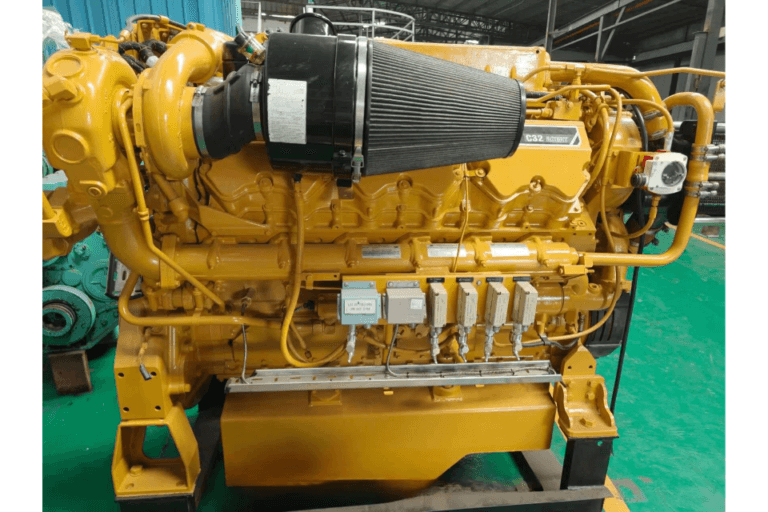
Caterpillar has reported a case in which three Cat C32 generator sets supplied a ten-building medical campus for more than a month following a transformer failure. That example isn’t a diesel generator engine overhaul threshold, but it explains why reliability margins matter.
For nonessential rental equipment, you may tolerate more risk.
For medical power? No.
Marine Diesel Engine Overhaul Thresholds
Marine diesel numbers can become nonsense very quickly.
A high-speed engine pushing a planing vessel, a medium-speed ferry engine, a harbor tug, an auxiliary generator, and a low-speed two-stroke main engine may all be described with the same broad phrase—marine diesel—but the mechanical similarities end surprisingly fast.
Bore size changes. Piston speed changes. Continuous rating changes. Fuel changes. Lubrication changes. Cooling-water treatment changes. The engine-room environment changes. Even the meaning of “overhaul” changes because large marine engines are often maintained component by component rather than treated as one sealed lump.
And then somebody asks for one universal marine diesel overhaul interval.
Ни за что.
На сайте MAN Energy Solutions Service Letter SL2023-744, published in August 2023, MAN explains that condition-based maintenance strategies can extend guiding overhaul intervals. The same letter warns that waste-heat recovery systems, exhaust-gas bypass arrangements, EGR, SCR, heavy propeller operation, slow steaming, and fuel quality can alter combustion-chamber heat load and wear.
That’s the real stuff.
For one 70-bore ME-C methane configuration, the tables show 16,000-hour overhaul intervals for cylinder liners, piston rings, piston crowns, and piston skirts. A cylinder lubricator is shown at 32,000 hours, while selected components carry expected service lives reaching 60,000 or 96,000 hours.
Don’t drag those figures onto a yacht engine.
They belong to the specified engine architecture, rating, operating conditions, inspection regime, and manufacturer guidance.
But the numbers do prove something: “marine diesel engine overhaul” is not one event at one universal hour count. It can be a sequence of inspections, measurements, overhauls, and component renewals spread across tens of thousands of operating hours.
The fleet evidence gets more interesting. In March 2024, MAN reported that its 51/60DF engine population had passed 10 million cumulative operating hours. The report covered 310 engines in service, cited availability of up to 98%, and stated that field maintenance intervals had exceeded a planned 36,000-hour schedule.
Does that mean every marine engine should be pushed beyond 36,000 hours?
Нет.
It means that good engineering, suitable loading, disciplined maintenance, correct fuel handling, cooling-water control, combustion balance, and proper inspection can support longer intervals than an unverified internet average would suggest.
Condition data earns extensions.
Optimism doesn’t.
Six Rebuild Signals That Matter More Than the Clock
The hour meter is still useful. I’m not throwing it away.
But when the hour count disagrees with physical evidence, I trust the physical evidence.
1. Oil Consumption Is Climbing
A mechanic says the engine “uses oil.”
Fine. How much?
That question often produces a shrug, and a shrug isn’t data.
Record liters or quarts added per 100 hours. Better yet, compare oil added with fuel consumed or useful production. An excavator can be tracked by oil per 100 hours and fuel per cubic meter moved. A generator can be measured against generated kWh. A haul machine can be compared with tonnes moved.
The trend matters more than the first number.
An engine that has consumed a stable amount of oil for 4,000 hours may be less concerning than an engine whose consumption has doubled during the last 500 hours, even when the newer number still looks “acceptable” to somebody reading a generic chart.
Rings wear. Liners polish. Valve guides loosen. Turbo seals leak. Crankcase pressure rises. Oil gets pulled into places it shouldn’t be.
Sometimes it’s subtle.
Cummins associates ring and liner problems with increased oil consumption, blow-by, power loss, and aftertreatment damage. That last item is easy to overlook. Oil ash and combustion deposits don’t politely remain inside the base engine; they can move downstream and create another repair bill.
So don’t ask only, “Is it burning oil?”
Ask, “How fast is the consumption rate changing, under what load, and where is the oil going?”
2. Blow-By Has Passed the Engine-Specific Limit
Blow-by is combustion gas leaking past the piston rings into the crankcase.
Every diesel has some.
That’s normal.
What isn’t normal is a steady increase in crankcase pressure under a controlled, repeatable load—particularly when it appears alongside rising oil consumption, low cylinder contribution, haze from the breather, seal leakage, or reduced power.
Caterpillar’s blow-by diagnostic equipment is used to evaluate ring wear, cylinder-wall damage, compression loss, and general engine condition. But the measured number has to be compared with service information for that engine model and test procedure.
Not somebody else’s engine.
Displacement matters. Speed matters. Load matters. Measurement units matter. Test temperature matters. Breather arrangement matters.
A six-liter engine and a 38-liter engine won’t share the same raw flow limit. Nor should they.
I’ve heard people diagnose a rebuild by removing an oil cap and watching it dance.
That’s a clue.
It isn’t a test report.
3. Oil Analysis Shows a Pattern, Not One Scary Number
One high iron result can start an argument.
Three rising iron results start an investigation.
There’s a difference.
A single sample can be affected by poor sampling technique, recent repair work, an extended drain, fresh break-in wear, residue in the bottle, or contamination introduced while the sample was taken.
That’s why I want consecutive reports, sampled from the same point, at comparable intervals, with operating hours and oil-add quantities recorded.
Watch iron (Fe), copper (Cu), lead (Pb), aluminum (Al), chromium (Cr), silicon (Si), sodium (Na), and potassium (K). Then look at viscosity, oxidation, soot, fuel dilution, water, and evidence of glycol.
The relationships matter.
High silicon with rising iron may point toward dirt ingestion. Sodium and potassium, combined with water or glycol indicators, may suggest coolant entry. Copper and lead movement can indicate bearing distress, although cooler cores and other copper-containing components can complicate the picture.
Ethylene glycol—C₂H₆O₂—in engine oil isn’t a casual “check again next service” finding when bearing metals are moving and the coolant level keeps falling.
John Deere’s fluid-analysis material discusses early detection of wear metals, dirt, water, coolant, fuel, soot, additive depletion, viscosity change, and oxidation.
That’s how oil analysis should be used.
Not as a fortune cookie.
4. Fuel Burn Is Rising While Productive Output Falls
A tired diesel often gets expensive before it gets dramatic.
The operator may not notice because the decline happens slowly. The machine still starts. It still moves. It still makes noise. But it needs more throttle to perform the same work, cycle times stretch, fuel use climbs, and the black-smoke complaint gets blamed on “heavy material.”
Measure it.
For an excavator, compare fuel burn with material moved or repeatable cycle performance. For a generator, track liters per kWh at controlled loads. For haul equipment, measure liters per tonne. For marine engines, review fuel consumption against power, vessel speed, propeller condition, weather, hull fouling, and engine load.
Yet don’t jump straight to rings.
A restricted air cleaner, charge-air leak, worn turbocharger, injector fault, timing issue, exhaust restriction, excessive aftertreatment backpressure, cooling problem, poor fuel, or weak hydraulic system can all make an engine look tired.
Here’s the ugly truth: a new set of liners won’t fix a plugged cooler stack.
It won’t repair a slipping fan drive.
And it definitely won’t restore a worn hydraulic pump.
5. Cylinder Balance Is Falling Apart
One weak cylinder can hide in a large engine for a long time.
The remaining cylinders pick up the work. Exhaust temperatures spread. Fuel corrections move. Smoke changes. The engine may feel slightly rough at one operating point and perfectly acceptable at another.
Then the fault grows.
Measure compression where the OEM procedure supports it. Review cylinder contribution, injector correction, peak firing pressure where available, and exhaust temperature under a steady, repeatable load.
One weak hole might point toward an injector, valve, seat, head, or localized cylinder problem.
Several weak cylinders—combined with rising blow-by, increased oil use, weak loaded power, and wear-metal trends—make an in-frame or full diesel engine overhaul far easier to justify.
But use the correct limits.
A 2024 Cummins service manual for one 1.5-liter IDI generator engine lists a minimum cylinder compression of 370 psi, or 2.55 MPa. That figure belongs to that engine and its specified procedure.
It is not “the minimum compression for a diesel.”
Engines don’t work like that.
6. The Cooling Problem Keeps Coming Back
An engine overheats once because a plastic bag blocks the radiator.
That’s one thing.
It overheats every time the machine works hard, coolant keeps disappearing, the fan sounds wrong, and the top tank temperature climbs faster each month?
Different story.
Repeated high-temperature operation attacks oil viscosity, piston-to-liner clearance, valve life, turbocharger durability, liner seals, head gaskets, and cylinder-head flatness. The warning light may go off after the machine cools, but the metallurgical damage doesn’t reverse itself out of politeness.
Pressure-test the cooling system. Check the cap. Measure radiator temperature drop. Confirm thermostat operation. Inspect water-pump flow, belt drive, fan speed, fan pitch, fan direction, shroud sealing, charge-air-cooler restriction, coolant concentration, freeze point, and the presence of combustion gas in the cooling system.
And clean the coolers properly.
Blasting a packed radiator from the wrong direction can drive debris deeper into the stack. Hammering soft fins with excessive pressure can reduce airflow while making the surface look clean from five feet away.
Seen it happen.
When the teardown is finally approved, don’t dismiss the small hardware. Reusing stretched, corroded, rounded, or incorrectly graded fasteners can compromise an otherwise careful overhaul.
Top-End Repair, In-Frame Rebuild, or Complete Replacement?
Not every smoky, oil-using, low-power diesel needs a complete overhaul.
And not every engine that still starts deserves to keep running.
The correct scope sits somewhere between those two lazy conclusions.
Keep Running—But Measure More Often
Continue operating when loaded power remains acceptable, fuel consumption is stable, blow-by isn’t moving, oil use is predictable, coolant stays where it belongs, and oil-analysis trends remain flat.
But create stop conditions.
Write them down.
For example: rebuild planning begins if oil consumption rises by a defined percentage, crankcase pressure crosses the OEM limit, glycol appears in two confirmed oil samples, loaded fuel rate worsens beyond the agreed threshold, or one cylinder repeatedly fails the balance test.
“Keep an eye on it” is not a maintenance strategy.
It’s how problems disappear between shifts until the engine puts a connecting rod through the block.
Choose a Top-End Overhaul
A top-end overhaul makes sense when the problem is concentrated in cylinder heads, valves, seats, guides, injectors, rocker gear, or the turbocharger while the liners, bearings, crankcase pressure, oil pressure, and bottom-end metal trends remain acceptable.
Generator engines with valve recession or unstable exhaust temperatures may fall into this group. So might a marine engine with injector leakage, one damaged head, or localized valve trouble.
This scope can save real money.
But only when the bottom end has been checked rather than ignored.
Choose an In-Frame Rebuild
An in-frame rebuild becomes reasonable when pistons, rings, liners, rod bearings, and related power-cylinder components show clear wear but the engine block, crankshaft, installation, and main structure remain serviceable.
It avoids some removal, transport, and reinstallation cost. On large equipment, that matters.
Still, I’ve seen cheap in-frames become expensive very quickly because the work stopped at the obvious parts. Nobody checked counterbore condition. Nobody measured crank journals properly. The turbocharger went back on with questionable end play. The oil cooler wasn’t cleaned. The injectors were reused because they “looked okay.”
Then the fresh cylinders ate the old contamination.
False economy.
Choose a Complete Overhaul or Engine Replacement
A complete overhaul—or replacement—makes more sense when the crankshaft, main-bearing structure, block, camshaft system, lubrication circuit, multiple cylinders, or major external systems show broad deterioration.
The same applies when parts availability is poor, the engine has an obsolete emissions configuration, the core is damaged, or the expected downtime of rebuilding is worth more than the difference in engine price.
If a planned diesel engine rebuild costs less than the risk-adjusted cost of continued operation, schedule it. If a replacement engine also reduces fuel use, improves emissions compliance, restores warranty protection, solves parts-supply problems, or cuts downtime, rebuilding the old core might not be the bargain it first appears to be.
Cheap isn’t always economical.
Three Real-World Findings Worth Remembering
The Caterpillar Verdalskalk case is useful because it deals with actual commercial decisions rather than theoretical engine life. The 2023 account described machine rebuilding commonly taking place near 15,000 hours, depending on condition, with one non-certified rebuild costing around 35% to 40% of a new machine.
Another rebuilt Cat 988H was expected to gain 6,000 to 7,000 additional hours.
That’s a business case.
It still isn’t a universal rebuild timer.
CARB’s off-road data gives us a different warning. Its overall equipment load factor was 38%, while the excavator group derived from fuel-and-hour data reached 49%.
Two hour meters can show the same number while the engines behind them have processed substantially different fuel volumes, cylinder pressures, heat loads, and work cycles.
The third example comes from MAN. Its March 2024 report covered 310 model 51/60DF engines that had exceeded 10 million combined operating hours, with availability reported at up to 98% and some field maintenance intervals moving beyond the planned 36,000-hour schedule.
That doesn’t tell us to delay maintenance.
It tells us that inspections, operating discipline, combustion balance, correct fluids, and reliable trend data can justify an extension. Without those things, “condition-based maintenance” is sometimes just a sophisticated phrase for hoping nothing breaks.
My opinion?
Fleet owners need to stop asking, “How long does a diesel engine last?”
Ask this instead:
How much verified life remains in this engine, at this load, in this environment, with this maintenance history—and what will one unplanned failure cost the business?
That question isn’t as neat.
It’s much more useful.
Вопросы и ответы
When should a diesel engine be rebuilt?
A diesel engine should be rebuilt when repeated condition data shows progressive internal wear—such as rising oil consumption, excessive blow-by, uneven compression, worsening fuel efficiency, abnormal wear metals, coolant contamination, or falling loaded power—that can’t be corrected economically through injector, turbocharger, cooling-system, hydraulic, or top-end repairs.
The hour meter should start the investigation, not end it. Test the engine under a repeatable load, compare the measurements with model-specific OEM limits, review multiple oil samples, and calculate the cost of continued operation before choosing an in-frame or complete diesel engine overhaul.
What is a typical diesel engine rebuild interval?
A typical diesel engine rebuild interval may fall near 10,000–15,000 hours for hard-worked construction engines and 20,000–30,000 hours or more for well-maintained generator engines, while selected commercial marine engines or individual components may have published overhaul and expected-life figures ranging from approximately 36,000 to 96,000 hours.
Those numbers are planning ranges—not universal deadlines. Load factor, cumulative fuel burn, idle time, dust, fuel quality, overheating, cooling performance, oil condition, operating rating, and maintenance discipline can move the real rebuild point thousands of hours earlier or later.
At how many hours should an excavator engine be rebuilt?
An excavator engine should usually enter structured condition assessment at approximately 8,000–10,000 hours, while many fleets begin budgeting a possible rebuild between 10,000 and 15,000 hours; clean, correctly maintained engines may run longer, whereas dust entry, overheating, fuel dilution, high-load cycles, or poor filtration can force earlier intervention.
Don’t authorize an excavator engine rebuild on hours alone. Check loaded blow-by, oil consumption, compression or cylinder contribution, boost, injector balance, coolant history, air-filter sealing, oil-analysis trends, productive fuel use, and hydraulic performance before deciding that the base engine is responsible.
When does a diesel generator need an overhaul?
A diesel generator needs an overhaul when controlled load testing and condition trends show declining reliability, rather than merely when the engine reaches a generic hour figure; prime-power units may be budgeted near 20,000–30,000 hours, while low-hour standby units are often governed by calendar aging, corrosion, exercise quality, fuel condition, and starting-system reliability.
Track crankcase pressure, exhaust-temperature balance, fuel consumption per kWh, oil and coolant condition, starting time, smoke, frequency recovery, voltage stability, and load acceptance. A short unloaded monthly run doesn’t prove that the engine can carry its rated emergency load.
How often should a marine diesel engine be overhauled?
A marine diesel engine should be overhauled according to its engine-family component schedule and verified operating condition, with many inspection or overhaul events occurring between approximately 16,000 and 36,000 hours, while selected commercial-engine components or major-overhaul programs may carry published figures extending toward 60,000 or 96,000 hours.
Fuel sulfur, lubricant feed rate, propeller loading, slow steaming, EGR, SCR, combustion balance, cooling-water chemistry, liner measurements, ring condition, scavenge inspections, bearing data, and the manufacturer’s service letters all affect the real interval. Vessel class and model-specific documentation outrank generic online averages.
Build the Rebuild Budget Before the Engine Builds It for You
Before approving—or postponing—the next diesel engine rebuild, put the evidence on one sheet.
Include the engine model and serial number, equipment application, total hours, annual utilization, estimated load factor, lifetime or recent fuel consumption, oil added per 100 hours, the last three oil-analysis reports, blow-by measurements, compression or cylinder-balance results, loaded fuel rate, coolant history, overheating events, and the financial cost of one day of downtime.
Then set three points:
The next inspection.
The planned overhaul window.
The absolute stop condition.
Don’t leave those decisions buried in somebody’s head. Operators change. Supervisors move. Maintenance records vanish. The engine keeps wearing anyway.
Plan the work while the engine is still a rebuildable core—before one worn ring scores a liner, one coolant leak damages the bearings, or a neglected temperature problem turns scheduled maintenance into a crane, a recovery truck, and a very uncomfortable meeting.